
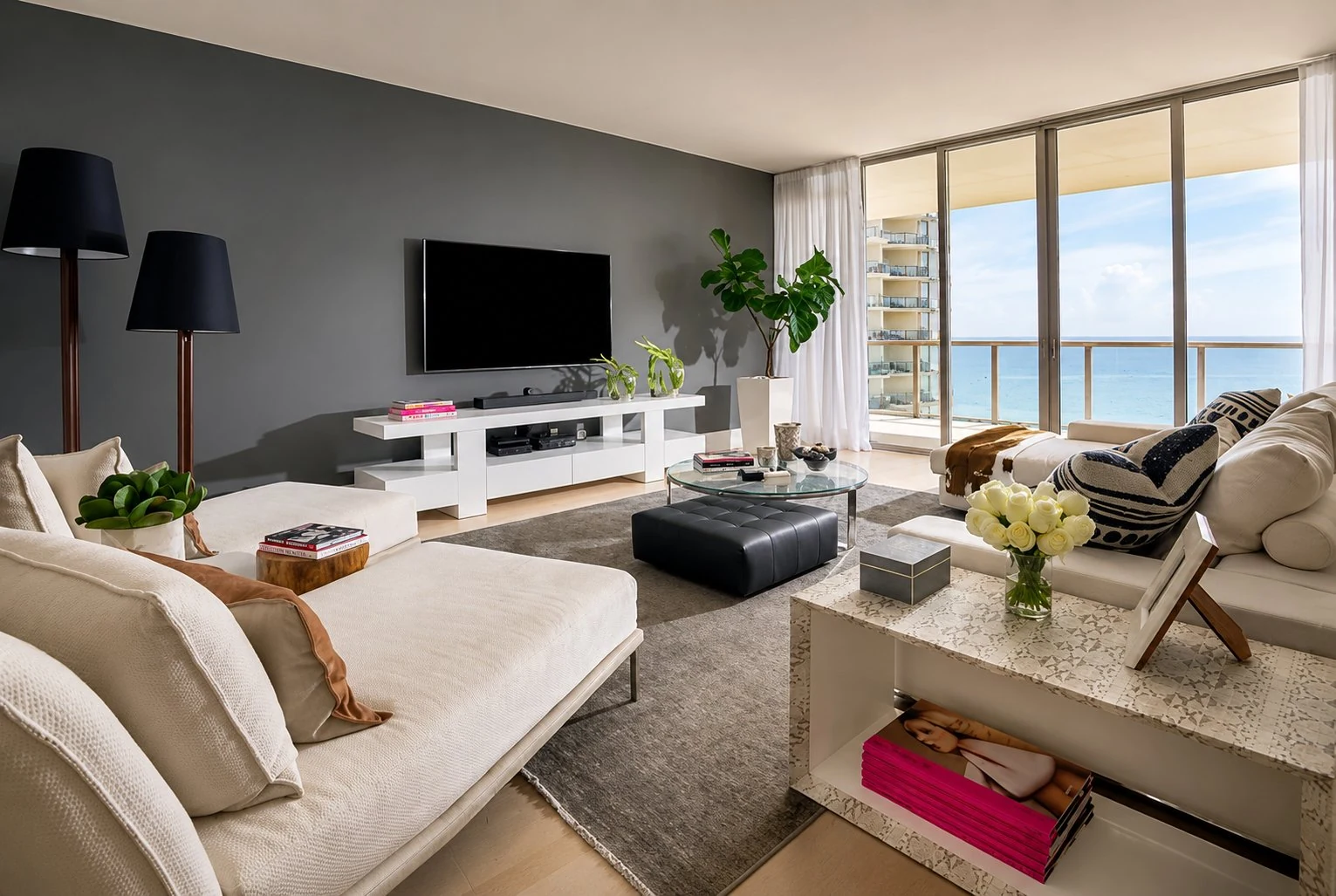
Relocating to Miami while managing the design of a new home from another state can feel overwhelming. For many homeowners moving from New York, California, or Chicago, the biggest concern is not simply aesthetics. It is whether the project will stay on budget, on schedule, and aligned with their expectations when they are not physically present to oversee every detail.
If you are making decisions from 1,500 miles away, the interior design studio you choose becomes far more than a creative partner. They become your eyes, your judgment, and your advocate on site. The portfolio tells you whether they can design beautifully. The conversations that follow tell you whether you can trust them to execute without you in the room.
Choosing the right interior design studio is one of the most consequential decisions you will make for your home. You are entrusting someone with your space, your vision, and a significant investment.
Before you schedule a single meeting, look closely at the portfolio. A studio’s portfolio reveals how they think, what they prioritize, and whether their work reflects the way you want to live.
What an interior design portfolio really reveals
Most people look at portfolios and react emotionally. That is a start, but it is not enough.
A portfolio is evidence. It shows you the range of projects a studio has completed, the quality of their decisions under pressure, and the consistency of their craft across different clients, budgets, and spaces. When you know what to look for, the evaluation becomes much more precise.
Consistency across different projects
A strong interior design portfolio does not look the same in every project. That would suggest the studio imposes its aesthetic on every client rather than listening.
What you want to see is consistency of quality, not sameness of style. Each project should feel tailored to a different family, a different building, a different lifestyle. Yet the level of finish, the attention to proportion, the care in material selection should remain equally high throughout.
Pay attention to how the studio handles transitions between spaces. Do the rooms feel like they belong to the same home? Does the design account for natural light, architectural features, and the way people actually move through a space?
Project range and residential focus
Interior design portfolio examples span many project types: hospitality, commercial, retail, and residential. Each requires a fundamentally different skill set.
If your project is a private residence, look for a studio whose portfolio is predominantly residential. The demands of a family home, a penthouse, or a luxury condo are distinct from those of a hotel lobby or a corporate office. A studio that has spent decades designing homes will understand acoustics, privacy, livability, and the way a space must function across different times of day and different seasons of life.
Furthermore, look at scale. If your project involves multiple rooms or a full-home redesign, confirm that the studio has successfully executed projects of similar scope. Interior design portfolio samples showing single-room renovations are different from those documenting full-building transformations.
In South Florida specifically, luxury condominium buildings add a layer of complexity that only local experience can navigate. Buildings like Grove at Grand Bay, 87 Park, and Fendi Chateau Miami Beach have association rules governing construction hours, elevator access, materials approval, and noise restrictions. A studio without deep experience in these buildings will lose weeks to procedural delays that a firm with established relationships solves in a single call.
Material quality in an interior design portfolio
Photographs can be deceiving. A skilled photographer can make ordinary materials look extraordinary. That is why sophisticated clients look beyond the wide-angle shots and study the details instead.
Pay attention to close-up images that reveal texture, joinery, finish quality, and craftsmanship. Look carefully at how the studio handles built-ins, custom millwork, upholstery, lighting integration, and stone applications. These are the elements that define a truly luxury residence and they quickly separate portfolios built on genuine execution from those built primarily on styling and photography.
In Miami’s climate, material specification is also a performance decision. High humidity, salt air in beachfront properties, and intense UV exposure can degrade finishes far faster than in northern cities. A studio with real South Florida experience understands that selecting materials is not purely about aesthetics. It is about durability over time.
Ask how the studio specifies upholstery for a bayfront penthouse versus an inland residence. Ask how they approach natural stone selection for outdoor terraces exposed to direct sunlight and moisture. The answers will reveal whether the studio thinks in terms of long-term livability and performance or simply in terms of visual impact.
You should also ask about sourcing. Does the studio work with trusted trade vendors and long-term supplier relationships, or do they rely primarily on retail selections? Studios with established access to premium suppliers often secure higher-quality materials, better customization options, and more reliable lead times than what is available to the general public. At Design Solutions Miami, these relationships have been built through more than 20 years of residential work across South Florida.
Style coherence and design philosophy
The interior design portfolio examples you review should give you a clear sense of the studio’s design philosophy, even when that philosophy adapts to each client.
Does the studio have a point of view? Can you read a consistent set of values, whether those values center on restraint, on boldness, on the integration of local culture, or on timeless proportions? A studio without a discernible philosophy is often a studio that simply executes requests, rather than one that elevates them.
Consider whether the studio’s aesthetic vocabulary aligns with what you are seeking for your own home. You are not hiring someone to replicate their portfolio in your space. But if there is a fundamental mismatch in sensibility, no amount of conversation will bridge it.
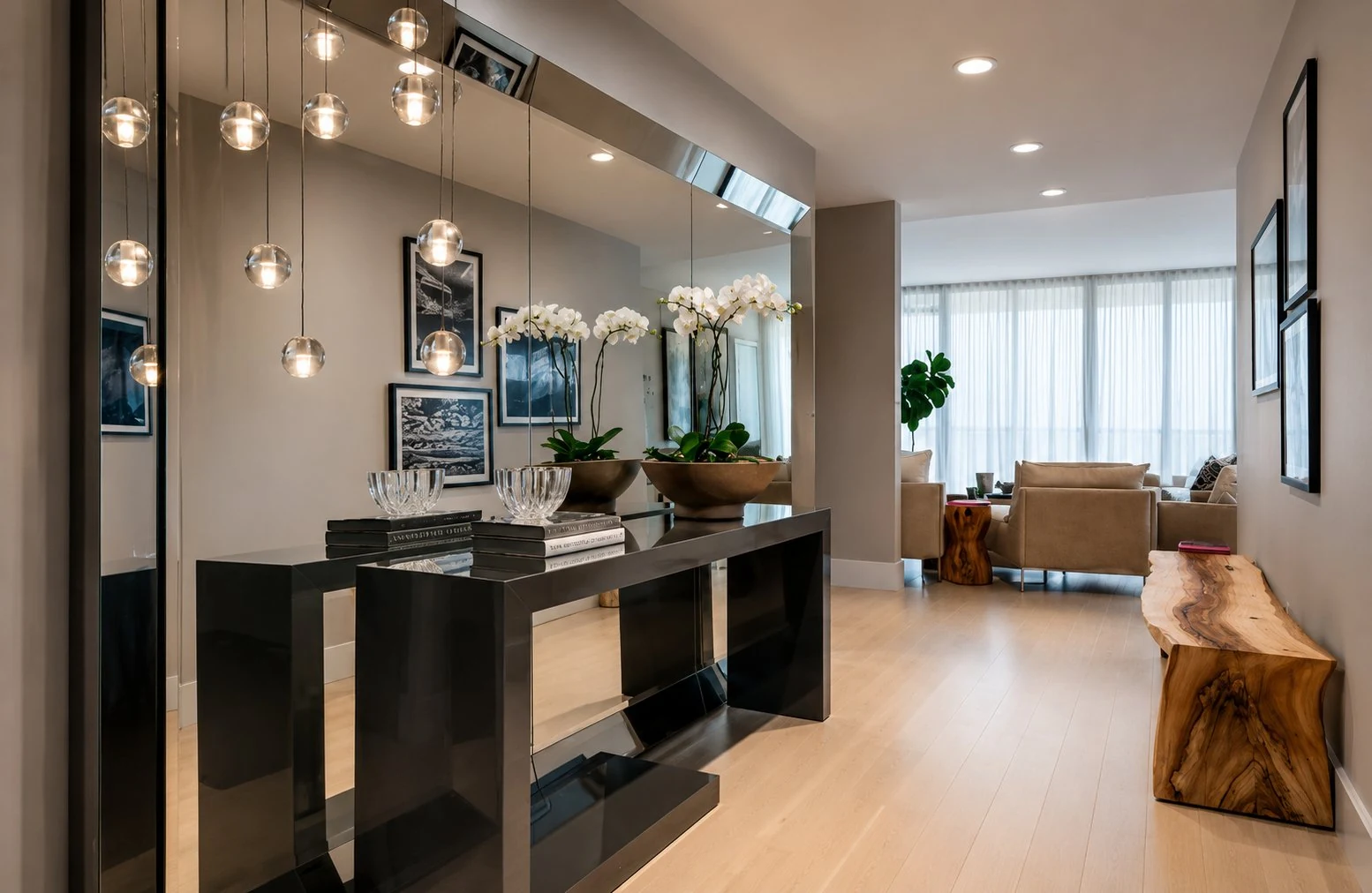
How to evaluate the before and after
When a portfolio includes before-and-after documentation, pay close attention. This documentation is most revealing when it shows the starting point clearly.
What was the baseline? A transformation from a completely raw space is different from a renovation of an already-beautiful home. The more challenging the starting point, the more revealing the result.
Also look at how the studio handles constraints. Every project has them: a difficult floor plan, an unusual ceiling height, a structural element that cannot be removed. How the studio solves problems is often more revealing than the finished photographs.
What the portfolio does not tell you
A beautiful portfolio answers the first question: can they design? But it does not answer the second: can they execute?
Execution is the harder half of interior design. It involves coordination with contractors and vendors, management of procurement timelines, oversight of installation, and the ability to adapt when, as always happens, something unexpected arises on site.
Ask directly. How does the studio manage day-to-day project communication? Who is your point of contact throughout the engagement? How are budget decisions documented and approved? A studio confident in its process will answer these questions without hesitation.
At Design Solutions Miami, each project is managed with daily on-site oversight from the time construction begins through final installation and styling. The boutique model means the firm accepts a limited number of projects simultaneously, so each client receives genuine attention at every stage. You can learn more about the full process on the Design Solutions Miami services page.
What to ask for when you request portfolio samples
When you move from browsing a website to a formal conversation, ask the studio to share interior design portfolio samples that are specifically relevant to your project type.
If you are designing a penthouse in Brickell, ask to see condominium projects in comparable buildings. If you are undertaking a full-home redesign in Coral Gables, ask for single-family residential examples at a similar scale. The more specific your request, the more useful the conversation becomes.
Also ask whether you can speak with a former client. A studio proud of its work and its relationships will welcome this request. The feedback from a homeowner who has lived in a Design Solutions Miami-designed residence for two or three years will tell you more than any photograph.
The last thing to look for before you hire
After reviewing project range, material quality, and style coherence, ask yourself one final question: does this interior design portfolio reflect a studio that listens?
The most technically accomplished portfolio belongs to a studio that imposes its vision. The most valuable portfolio belongs to a studio that amplifies yours.
The right interior design portfolio does not make you feel like you are looking at someone else’s home. It makes you feel like you are looking at what your home could become. That is the standard worth holding every studio to.Ready to see what 450+ completed projects in South Florida look like in practice? Explore the Design Solutions Miami portfolio and request a project review to discuss your vision.
