
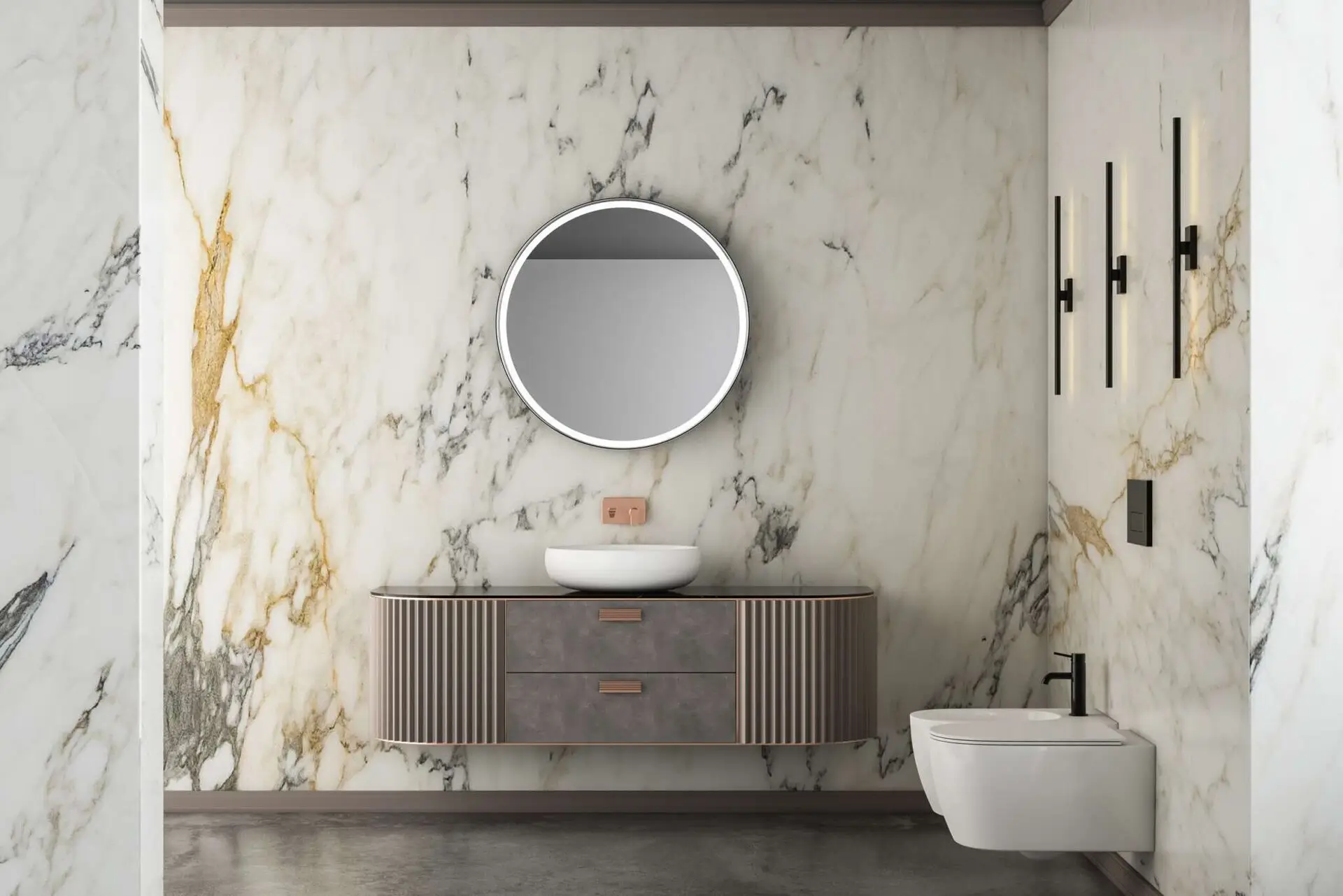
Marble doors are one of the most unexpected and impactful design decisions available to luxury homeowners in Miami and they represent only one expression of a material that has defined architectural excellence for millennia. From the temples of ancient Greece to the penthouses of modern Brickell, marble continues to set the standard for residential luxury. Yet despite its long history, it remains one of the most versatile and widely misunderstood materials in interior design today.
Most homeowners associate marble with floors and bathroom countertops. Those are valid applications, but they represent only a fraction of what this material can do. Marble doors, in particular, remain underutilized in residential projects despite being one of the highest-impact choices available in luxury interior design. For clients undertaking a full-scope residential project in South Florida, understanding the full range of marble applications is the first step toward using the material with intention rather than convention.
What makes marble exceptional for interior design
Marble is a metamorphic stone formed when limestone is subjected to extreme heat and pressure over geological timescales. That process produces a material with properties that make it genuinely well-suited to demanding residential environments – not merely a beautiful surface, but a functional one.
The word marble derives from the Greek marmar, meaning “to glisten”, a reference to the stone’s naturally reflective surface when cut and polished. That reflectivity is not purely decorative. In warm climates like Miami’s, marble’s thermal mass allows it to absorb heat during the day and release it gradually, contributing to a naturally cooler indoor environment. This is one reason marble floors have remained the dominant flooring choice in South Florida luxury residences for generations.
Beyond thermal performance, marble offers:
- Durability: Properly sealed and maintained, marble resists general wear and handles high-traffic conditions in residential settings with minimal degradation over time.
- Uniqueness: No two slabs of marble are identical. The veining, color variation, and surface character of each piece are determined by the specific mineral composition and geological history of the deposit it came from. In a marble interior design context, this means every application is inherently one of a kind.
- Compatibility: Marble works alongside virtually every other natural material — wood, brass, bronze, linen, travertine — without competing. In any marble interior design scheme, it anchors a palette rather than dominating it.
- Ease of maintenance: Contrary to common perception, marble is straightforward to care for. Regular cleaning with a pH-neutral or specialized stone cleaner, combined with periodic resealing, preserves both its surface and its structural integrity indefinitely.
1. Marble doors: pivot, passage, and kitchen formats
Marble doors represent one of the most striking material decisions available to luxury residential clients and one of the least expected. Where a standard door disappears into its surroundings, marble doors command attention. Each one functions simultaneously as architecture, furniture, and art.
Marble doors are increasingly specified in DS Miami projects precisely because they create a before-and-after effect: the moment they are installed, every adjacent surface reads differently. They raise the perceived quality of the entire space rather than operating in isolation.
The most common formats in luxury residential projects include:
- Pivot doors: Floor-to-ceiling marble doors on a pivot system at a primary entry or between major interior volumes create an immediate statement. The weight and scale of the stone, combined with the precision engineering required to hang them correctly, communicate a level of craft that standard door systems cannot approach.
- Interior passage doors: Marble doors between a master suite and its bathroom, or between a kitchen and a service corridor, introduce material continuity that elevates the entire sequence of spaces. They work particularly well when the stone used in the door is drawn from the same slab series as the flooring or wall cladding in the adjacent room.
- Kitchen doors: A stone door at the entrance to a kitchen – especially in open-plan residences where the kitchen is visible from the main living area – bridges the material languages of the two spaces and elevates the kitchen beyond its purely functional role.
For clients considering this application for the first time, the critical decisions involve slab selection, thickness, structural reinforcement, and the hardware system required to support the stone’s weight. These are engineering and design decisions that must be made in coordination. Design Solutions Miami manages this process as part of its full-service project scope, ensuring that marble doors deliver on both their visual promise and their long-term functional performance.
2. Marble showers: where performance meets luxury
The shower is one of the most intensive use environments in any residential interior. Surfaces are exposed to water, steam, temperature cycling, and cleaning agents on a daily basis. Marble interior design in a shower context requires both material knowledge and precise specification to perform correctly over time.
Marble is particularly well-suited to shower applications for several reasons. Its surface is non-porous when properly sealed, making it resistant to the moisture penetration that causes deterioration in less dense stone types. Its thermal properties mean it does not feel as cold underfoot as ceramic tile or engineered stone. And its visual character — especially in large-format slabs with continuous veining — creates a sense of spatial coherence that tiled surfaces cannot replicate.
The most effective marble shower installations in DS Miami projects typically involve:
- Book-matched slabs: Cutting consecutive slabs from the same block and opening them like the pages of a book produces mirror-image veining across adjacent walls. The effect is dramatic and unmistakably intentional: one of the defining markers of high-end marble interior design.
- Honed rather than polished finishes: In wet environments, a honed (matte) finish provides better grip underfoot than a polished surface, while still communicating the depth and character of the stone.
- Integrated niches and bench seating: Continuing the marble into recessed niches and built-in bench surfaces creates visual continuity and eliminates the material transitions that interrupt the coherence of the space.
Maintenance for a marble shower is straightforward: a specialized marble or granite cleaner for daily use, and reapplication of penetrating sealer every twelve to eighteen months depending on use intensity. The investment in correct specification at the outset makes long-term maintenance a minimal concern.
3. Marble kitchen islands: a functional centerpiece
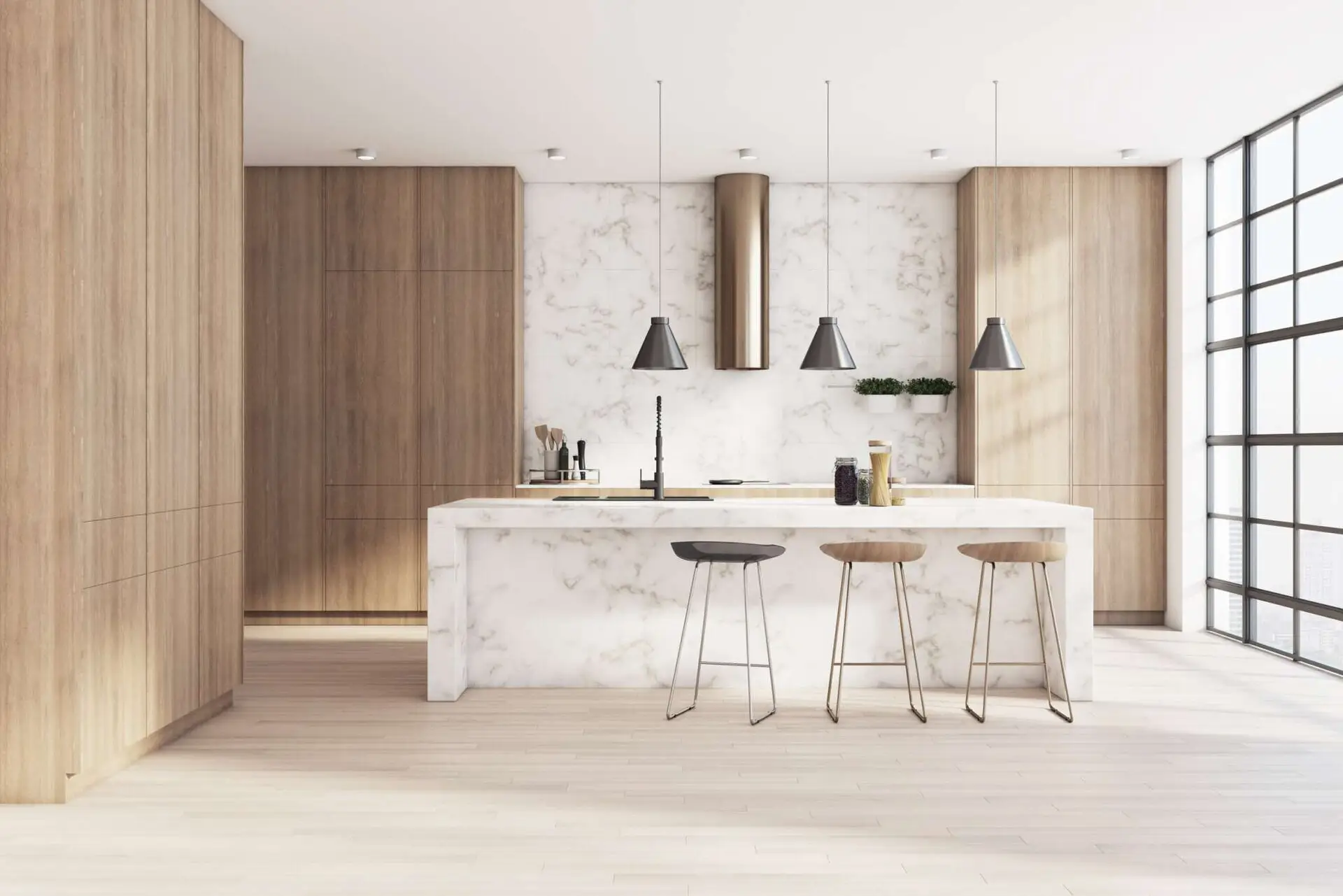
A marble kitchen island is one of the most consistently high-impact applications of marble interior design in luxury residential projects. It anchors the kitchen spatially, provides a working surface with genuine material presence, and functions as the visual center of a room that, in open-plan layouts, is visible from the living and dining areas as well.
The common concern about marble in kitchen environments is porosity — marble can absorb staining agents including wine, citrus juice, and cooking oils if left unsealed or if the sealant is not maintained. This concern is legitimate but manageable. The practical response is twofold: specify a penetrating sealer appropriate to the stone and the use conditions, and consider the color and veining of the marble with staining in mind.
For kitchen islands in active use, darker marble varieties — black Marquina, forest green, deep gray — are more forgiving than white Carrara or Calacatta in terms of visible staining. They also pair particularly well with the brass hardware, custom cabinetry, and statement lighting fixtures common in DS Miami kitchen projects.
White and light marble remains a valid choice for kitchen islands in households where the space is used less intensively, or where the client understands and accepts the maintenance requirements. In either case, the slab selection process — reviewing full slab layouts rather than small samples — is essential to ensuring the finished result matches the design intent.
Marble in Miami’s luxury residential market
Miami’s residential design market has a particularly strong affinity for marble interior design, driven by the material’s thermal properties, its compatibility with the coastal and Mediterranean aesthetic influences that define much of South Florida’s architectural history, and its enduring association with the kind of bespoke, uncompromising luxury that DS Miami clients expect.
Luciana Fragali, founder of Design Solutions Miami, has incorporated marble across more than 450 completed residential projects spanning Coconut Grove, Coral Gables, Bal Harbour, Miami Beach, and beyond. The application varies by project — marble doors on a pivot system in a Brickell penthouse, book-matched shower walls in a Coconut Grove estate, a dramatic black marble island in a Coral Gables kitchen — but the underlying principle is consistent: marble works when it is selected and specified with the full context of the space in mind, not applied as a generic luxury signal.
For homeowners planning a luxury residential project in Miami and considering marble doors, showers, or islands as part of their design, the conversation begins with understanding which application, which stone, and which finish will serve both the aesthetic and the practical demands of the space.
