
Miami’s climate is not a backdrop to interior design — it is one of its primary design inputs. The city’s tropical monsoon conditions, intense solar exposure, persistent humidity, and annual hurricane season all impose real constraints on what works inside a home and what fails within months.
For affluent homeowners undertaking a full-scope miami interior design project in South Florida, understanding the relationship between climate and design is the difference between a home that performs beautifully year after year and one that requires constant maintenance and costly replacements. This guide covers the key climate factors every miami interior design decision must address.
Why miami interior design must respond to climate
Miami sits in one of the most climatically demanding environments for residential design in North America. Average humidity levels exceed 75% for most of the year. Ultraviolet radiation is among the highest measured in the continental United States. And from June through November, the region faces hurricane-force wind events that can alter material performance requirements entirely.
These are not abstract conditions. They directly affect which materials hold up, which finishes last, which spatial configurations promote comfort, and which window systems qualify for building code compliance. Experienced miami interior design firms build climate literacy into every project decision, from the initial material schedule to the final accessories layer.
At Design Solutions Miami, this expertise is embedded in more than 20 years of residential practice across Coconut Grove, Coral Gables, Bal Harbour, Miami Beach, and surrounding neighborhoods. The result is a design process that produces beautiful spaces precisely because it never ignores the environment they inhabit.
Material selection: what lasts in Miami’s humidity
Material durability is one of the most consequential decisions in any miami interior design project. Miami’s humidity creates conditions that degrade untreated or poorly specified materials rapidly. Wood that performs well in New York or Los Angeles may warp, swell, or develop mold within a single rainy season if not properly treated or substituted.
The most resilient material choices for Miami’s residential interior environment include:
Bamboo. A fast-growing, sustainable material with natural dimensional stability. It resists moisture-related movement better than most hardwoods and performs well in high-humidity interior applications.
Teak. A dense tropical hardwood with naturally occurring oils that resist rot, fungal growth, and moisture absorption. Frequently specified for bathroom cabinetry, outdoor-adjacent spaces, and flooring in Miami luxury residences.
Aluminum and stainless steel. Both metals resist corrosion in salt-air environments. Aluminum is particularly common in window frames, door hardware, and custom furniture frames in coastal Miami properties.
Concrete. Increasingly favored in contemporary miami interior design for its thermal mass, its resistance to humidity, and its compatibility with the clean-lined aesthetic common in Brickell and Design District residences. Properly sealed concrete flooring is one of the most low-maintenance options available in this climate.
Linen and performance-grade fabrics. For upholstery, breathable natural fibers like linen and cotton outperform heavier materials in comfort and longevity. Solution-dyed acrylics, engineered for outdoor use, are now commonly specified for indoor-outdoor transitional spaces because of their UV resistance and ability to dry quickly after exposure to humidity.
For wood elements that remain part of the design, marine-grade sealants and vapor-barrier underlayments provide meaningful protection. Powder-coated metal finishes offer similar insurance against corrosion in salt-air conditions. These are not precautions — in Miami’s climate, they are standard specification practice.
Color palette: light, heat, and the psychology of tropical living
Color strategy in miami interior design serves two simultaneous functions: aesthetic and thermal. Miami’s light is more intense and directional than in northern cities, which means that successful miami interior design in this market requires color decisions calibrated specifically to Florida’s solar conditions.
Light-reflective palettes anchored in white, warm ivory, sand, and soft greige remain the most consistent performers in Miami residential interiors. They read as cool and spacious during the day and hold warmth under artificial light in the evening. They also reduce solar heat gain by reflecting rather than absorbing direct radiation through glass.
Accent color is where Miami’s tropical identity asserts itself most naturally. Turquoise, coral, terracotta, and aged gold are recurrent in DS Miami projects because they reference the coastal and Latin American influences that define the city’s cultural identity. Used as accents against a restrained primary palette, they add energy without visual noise.
Cool tones, including sage, seafoam, and dusty blue, have a measurable psychological effect on perceived temperature in a room. For spaces with significant solar exposure, they can reduce the subjective sense of heat without requiring additional mechanical cooling.
Window treatments: managing solar gain and storm protection
Windows in Miami luxury residences are larger than in almost any other residential market in the country. The views they frame are part of the design. But without effective treatment, those same windows introduce solar heat gain, UV degradation of materials, and significant vulnerability to hurricane-force wind pressure.
Effective window specification in miami interior design typically involves:
Impact-rated glazing. The Florida Building Code requires that all new construction in Miami-Dade County meet High-Velocity Hurricane Zone (HVHZ) standards. Impact windows and doors are not optional in new builds and most renovation projects in the area. They also provide meaningful acoustic insulation from urban environments and reduce UV transmission significantly.
Solar shades. Engineered to block between 5% and 14% of visible light transmission while preserving outward views, solar shades reduce heat gain and protect upholstery, flooring, and artwork from UV fading. In east- and west-facing rooms with peak solar exposure, they represent a significant improvement in both comfort and material longevity.
Sheer curtains and layered treatments. For spaces where softness and diffused light are the design priority, sheer linen panels allow natural light to enter while reducing glare. Layering sheer panels with heavier drapery gives residents full control over light levels across the day.
The selection of window treatment hardware also matters in Miami’s climate. Moisture-resistant curtain rods, rust-proof track systems, and UV-stabilized fabrics prevent the premature degradation that affects poorly specified window treatments in high-humidity environments.
Ventilation and airflow: designing for thermal comfort
Mechanical cooling carries the primary load in Miami’s interior thermal environment, but passive ventilation strategies remain relevant and valuable in residential miami interior design, particularly in neighborhoods like Coconut Grove and Coral Gables where single-family homes and older building stock make natural airflow a viable complement to air conditioning.
Ceiling fans are among the highest-value additions to a Miami interior. At the scale of a residential space, a well-specified ceiling fan reduces the perceived temperature by three to four degrees, allowing thermostat setpoints to be raised without a reduction in comfort. For large open-plan living areas in high-rise residences, multi-motor fan systems can maintain airflow across extended spaces.
Open floor plans — standard in contemporary miami interior design — support natural air circulation in a way that compartmentalized layouts do not. Combined with strategically positioned openings on prevailing wind axes, they can create meaningful cross-ventilation in the transitional months when mechanical cooling is not always necessary.
Outdoor living: extending the interior to Miami’s climate
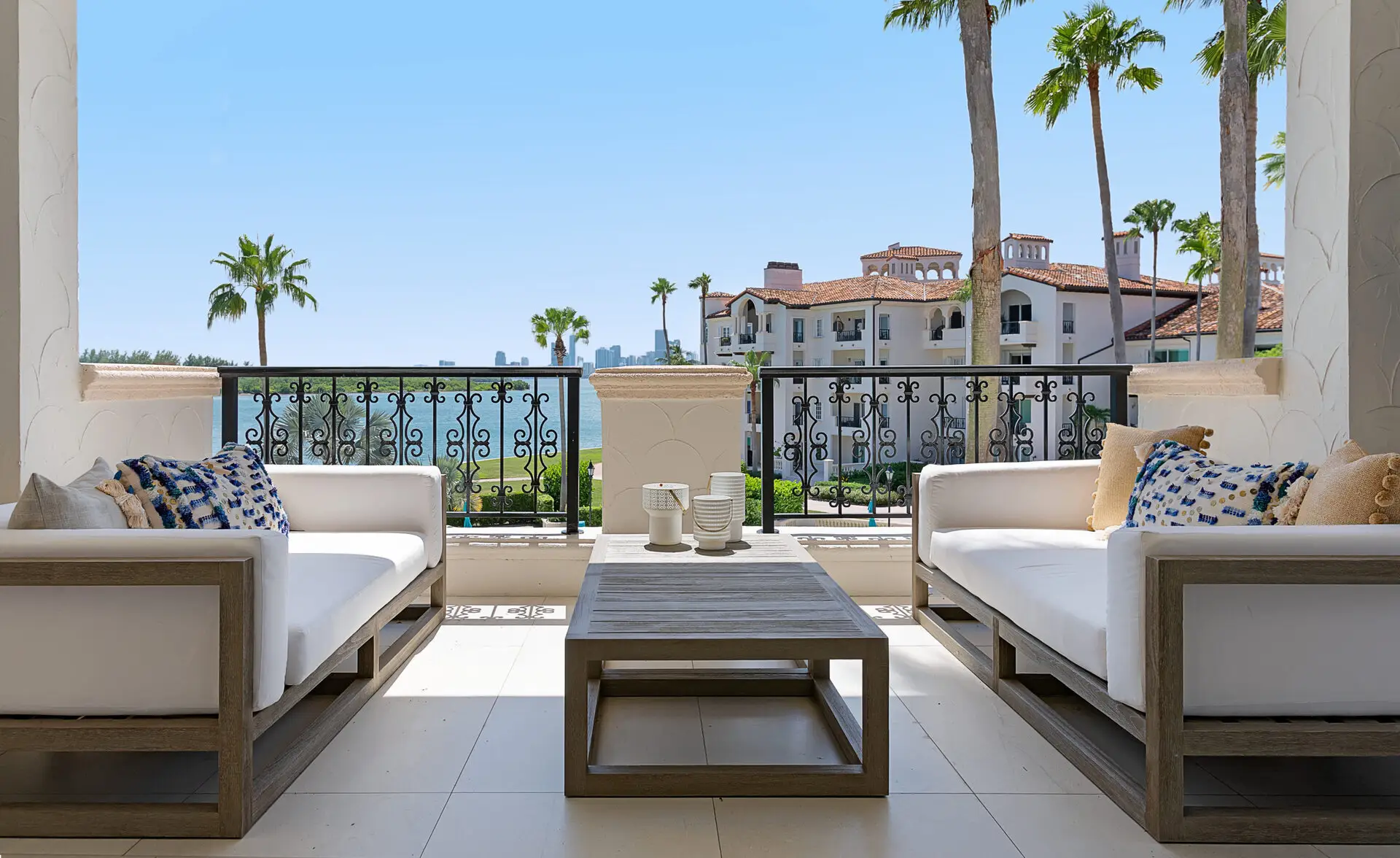
Miami’s climate is one of the defining arguments for outdoor living as a design priority. The approximately 250 days of sunshine per year and mild winter temperatures mean that a well-designed terrace, loggia, or private garden is a usable room for most of the calendar year.
In DS Miami projects, outdoor spaces are designed with the same precision as interior rooms: material specifications, furniture selection, shade structures, lighting, and planting are all coordinated into a coherent whole rather than treated as ancillary afterthoughts.
Weather-resistant teak and aluminum furniture, solution-dyed acrylic cushions, pergola structures that provide shade without blocking airflow, and curated tropical planting including palms, heliconias, and bromeliads are recurring elements. The integration of indoor and outdoor space is also one of the features most valued by the South Florida residential market. Well-designed exterior spaces consistently contribute to both quality of life and long-term property value.
Hurricane preparedness as a design discipline
Hurricane preparedness in miami interior design is not a single decision — it is a discipline that runs through the entire project. From the specification of impact glazing at the envelope level to the selection of furniture weights and fastening systems for outdoor terraces, every decision that involves a movable or exposed element has a hurricane-season dimension.
The Florida Building Code’s HVHZ requirements define minimum structural standards, but experienced design teams go further. Furniture on exposed terraces is specified for weight, anchoring capacity, and storage logistics. Interior accessory arrangements account for the need to secure or store decorative objects during storm events. Safe rooms and interior refuges are considered at the spatial planning stage rather than retrofitted after the fact.
This level of foresight does not compromise the aesthetic quality of a project. It ensures that the quality survives.
Designing for Miami’s climate: what to expect from a full-service firm
Every decision in a miami interior design project — material, color, spatial configuration, window system, ventilation strategy — is a response to a specific set of environmental conditions. The firms that produce the most enduring miami interior design work are the ones that treat climate not as a constraint to work around, but as a design brief to work with.
Design Solutions Miami has built its practice on exactly this principle. With more than 450 completed residential projects across the most demanding microclimates in South Florida, the firm brings technical climate literacy and design excellence to every engagement.
If you are planning a luxury residential project in Miami and want a design team that understands both the environment and the aesthetic standard you expect, schedule a project review with Design Solutions Miami.
